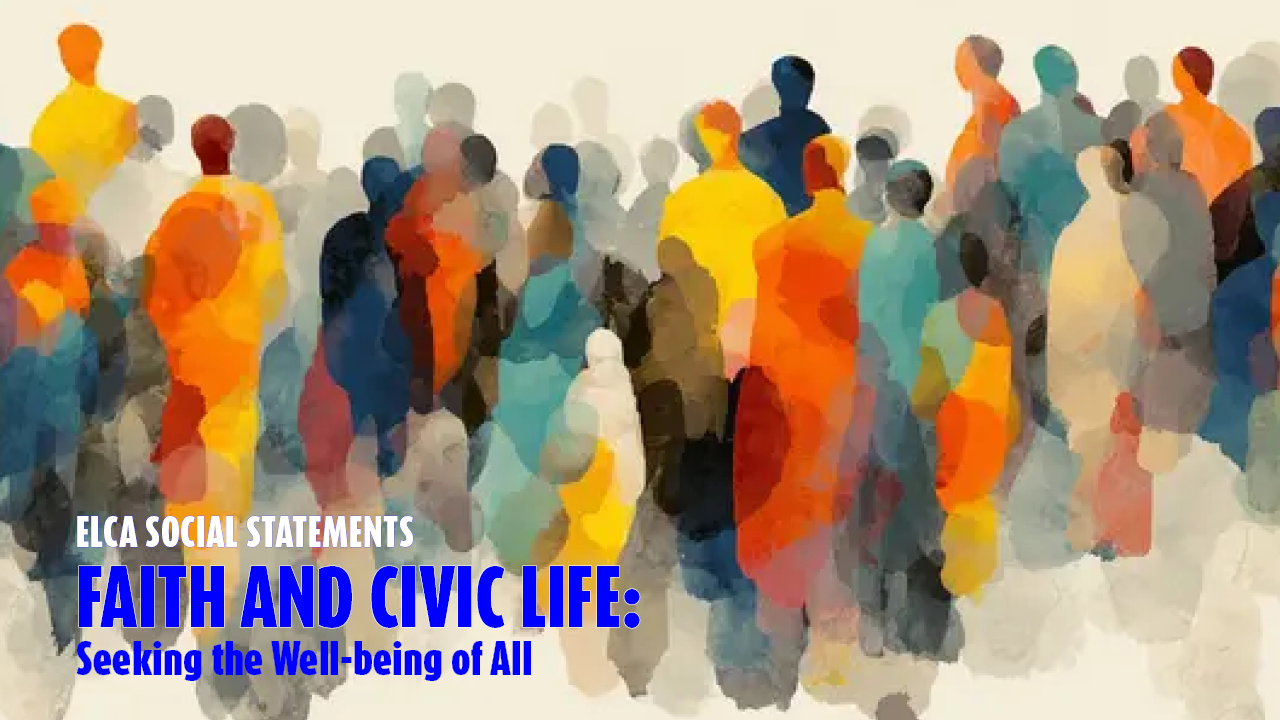
What does our Lutheran faith have to do with government, elections, public policy and political participation? The ELCA’s newest social statement, Faith and Civic Life: Seeking the Well-Being of All, offers a comprehensive Lutheran response: God calls people of faith to participate in civic life for the good of our neighbors and the well-being of all.
The statement begins with familiar words from the Lord’s Prayer: “Your kingdom come, your will be done, on earth as in heaven. Give us today our daily bread.” Luther’s Small Catechism reminds us that “daily bread” includes not only food and shelter, but also faithful neighbors, upright leaders and good government. Civic life, then, is not separate from Christian discipleship. It is one of the places where we live out our baptismal promises to serve all people and strive for justice and peace.
The statement affirms government as a gift intended to foster good order and the common good, while recognizing that every human institution is subject to sin. Lutherans therefore approach government with both respect and vigilance—cooperating when it serves our neighbors, and questioning or resisting abuses of power when necessary. Laws, policies and public institutions should be evaluated by whether they protect human dignity, expand meaningful participation and serve the well-being of all, especially people who are marginalized or oppressed.
The statement also makes clear that faithful civic engagement is not the same as partisanship. No political party, candidate, nation or ideology can claim a Christian’s ultimate loyalty. Instead, the church is called to speak and act from its theological convictions, participate respectfully across differences, distinguish fact from falsehood and resist rhetoric that dehumanizes others.
Among the contemporary concerns addressed are hyperpartisan polarization, misinformation, the influence of money in elections, religious freedom, civic education and Christian nationalism. The statement rejects Christian nationalism as a distorted form of patriotism that attempts to fuse selected Christian beliefs with national identity, crosses into idolatry and undermines the constitutional sovereignty of “we the people.”
For LAMA, this statement provides an important foundation for advocacy. It affirms that faith-based organizing can bring people together around shared concerns; that religious communities may—and sometimes must—challenge public policy; and that advocating for vulnerable neighbors is a faithful expression of our calling, not an improper intrusion of religion into public life.
May we be empowered “to courageously seek the well-being of all through our participation in civic life.”
The statement was adopted by a vote of 762–16 at the ELCA Churchwide Assembly on August 1, 2025, in Phoenix.
Congregations and groups are encouraged to read, discuss and use it as a guide for faithful participation in civic life.
Not a fan of reading? Listen to the complete Social Statement in six parts on the ELCA’s Advocacy podcast, Here I Pod.
Study Guide Available
Download the six-session congregational study guide - the 6.7MB Zip folder contains – 6 Civic Life Study Guides Slides Sessions, Study Guide Participation Guide, Facilitators Guide and a Study Guide Confession and Absolution Slides.