You spoke up. Congress listened. Humanitarian funding is PASSED.
This moment bears witness to the power of faithful persistence. Your prayers, your advocacy, and your public witness on behalf of neighbors facing hunger and hardship are making a real and measurable difference.
You’ve been busy! Partial list below.
ELCA Action Alert: Ensure Release of Funds for HIV/AIDS Programs
ELCA Action Alert: Protect International Food Aid in the Farm Bill
ELCA Action Alert: Support Hunger Programs in the Federal Budget!
ELCA Action Alert: Invasion of Gaza City Unacceptable, Ceasefire and Humanitarian Aid Overdue
ELCA Action Alert: Stop largest healthcare and food assistance cuts in US history
ELCA Lenten Action Alert: Oppose cuts to hunger programs
Over the past year, we have watched with concern as funding for humanitarian assistance, global health, and life-saving nutrition programs faced serious threats in the federal budget. These were not abstract line items—they were commitments to human dignity, to children and families, and to a world where life is protected and nurtured.
Rather than turning away in discouragement, Lutheran advocates stepped forward. We contacted elected leaders. We wrote, called, met, and spoke—grounded in faith and guided by conscience—reminding lawmakers that budgets are moral documents and that care for the vulnerable must remain a priority.
As a result of recent action in the U.S. House, billions of dollars have now been designated for humanitarian aid, food security, nutrition, and global health initiatives. This funding will save lives and bring tangible hope to families and communities around the world.
This has been a difficult season, and progress has not come easily. But this outcome reflects the strength of collective, faith-rooted advocacy. Thank you for raising your voice alongside fellow Lutherans and people of faith who believe that love of neighbor belongs in our public life.
We invite you to pause in gratitude for this moment—and then to take one more faithful step. Reach out to your members of Congress to thank them for their work. Bipartisan action on issues like these is never guaranteed, and it matters that our leaders hear appreciation as well as accountability. Let them know that these commitments reflect the values of their constituents and the moral convictions of our faith.
Together, we continue this work—trusting that God is at work through justice, compassion, and the voices of a faithful people.
The appropriations and funding for food security and nutrition were confirmed as part of the Fiscal Year 2026 appropriations legislation that Congress passed and the President signed on February 3–4, 2026. That package effectively completed the annual appropriations process for nearly all federal agencies and programs after earlier shutdown delays and continuing resolutions.
1. Domestic Nutrition Programs (USDA Safety Net)
Even though the final package was signed in early February 2026, the appropriations for key domestic nutrition programs — including SNAP (food stamps) and the Special Supplemental Nutrition Program for Women, Infants, and Children (WIC) — had already been fully funded in the full-year USDA appropriations bill that was enacted prior to the shutdown and carried forward into the FY26 consolidated package timeline.
SNAP and WIC were fully funded through FY 2026, with authorities in place to continue benefits through at least September 30, 2026 (i.e., the end of the fiscal year).
Other domestic nutrition programs like school breakfast and lunch, Summer EBT, and the Commodity Supplemental Food Program were protected and funded within that same appropriations structure.
Because these nutrition programs were already funded through the structure of the ongoing appropriations process — and USDA’s funding was included in measures ratified before the Feb. 3 package — their funding did not lapse when the partial shutdown occurred and remained in effect once the full FY 2026 package was completed in early February.
2. Food Security & International Nutrition Programs
For global food security and nutrition programs (which are typically funded in the State, Foreign Operations, and Related Programs appropriations account), the final FY26 appropriations package that was signed in early February did include funding for:
Humanitarian assistance accounts that support emergency food aid and nutrition intervention;
Foreign aid and development food security programs, though exact line items are often detailed in the explanatory statements rather than the topline public summary.
The broad foreign aid and global health package — estimated around $50 billion in total for FY 2026 includes food security and nutrition elements (i.e., humanitarian food aid, nutrition assistance components of humanitarian responses, and related water/sanitation support). While precise breakdowns by program (e.g., specific amounts for Feed the Future labs or McGovern-Dole) are often delineated in agency budget justifications or committee reports, the overarching appropriation process that culminated with the Feb. 3/4 signing is the vehicle that made those funds legally available.
Timeline
Congress reached agreement and passed most of the 12 FY26 appropriations bills throughout late 2025.
A partial government shutdown occurred Jan. 31 – Feb. 3, 2026, because lawmakers hadn’t finished the omnibus appropriations legislation.
On Feb. 3, 2026, Congress passed and the President signed a consolidated appropriations act that completed FY26 funding for nearly all agencies and programs — including those that underwrite nutrition and food security programs.
$9.42 Billion for Global Health as US Foreign Aid Bill Passes
The US House of Representatives passed a more than $1 trillion spending package, bringing an end to a five-day partial government shutdown over Department of Homeland Security funding.
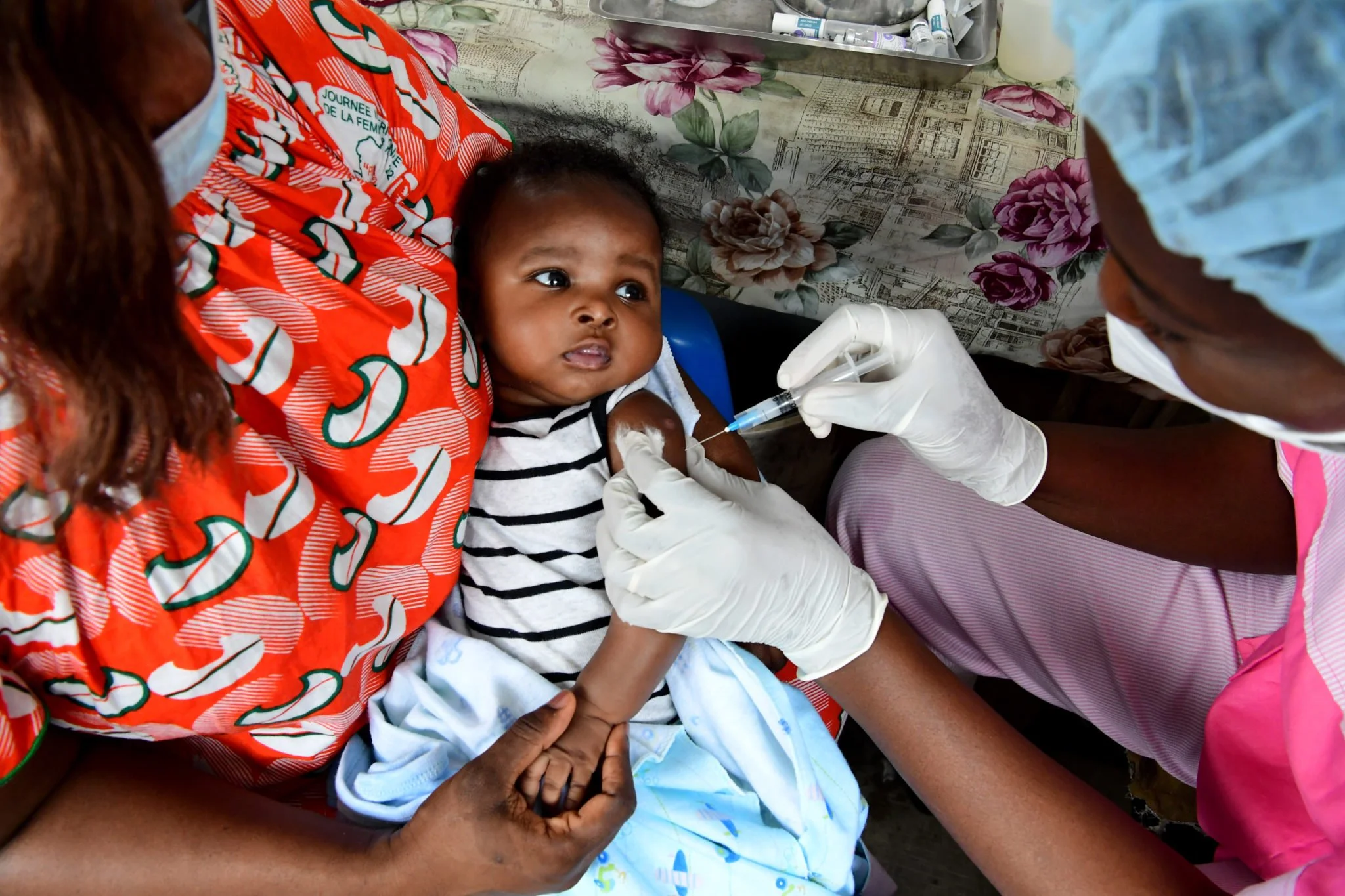
A baby is being weighed, measured and vaccinated in the health center of Gonzagueville, a suburban of Abidjan, in the South of Côte d’Ivoire. The US is the largest single contributor to global health funding.
Among the allocations is a $9.42 billion package for global health programs – signaling strong bipartisan support and maintaining significant global health aid.
The Fiscal Year 2026 (FY26) National Security-State Department Appropriations Bill maintains funding for global health at a substantially higher level than envisaged by the Trump administration, in an apparent bipartisan rejection of the administration’s proposed cuts.
The $9.42 billion package agreed to by the US House and Senate, and signed into law by the President, is lower than the $12.4 billion allocation in 2024 and 2025 – but it is still $5.7 billion more than requested last September by US President Donald Trump in his America First Global Health Strategy.
Although the administration requested major cuts to foreign aid, Congress’s version of the bill preserves flagship global health programs like President’s Emergency Plan for AIDS Relief (PEPFAR), the Global Fund to Fight TB, AIDS and Malaria, and HIV/AIDS programs previously administered through USAID – and reasserts Congress’s role in government spending.
The global health allocations are part of a larger $51.4 billion foreign aid spending package for the 2026 fiscal year. That foreign aid bill, while a 16% cut from 2024, is nearly $20 billion more than what the Trump Administration initially requested.
The broader bill also includes $5.4 billion in funding for humanitarian assistance and comes as the Trump administration moves forward on a $11 billion plan for direct bilateral assistanceto developing country governments – some of which would also be dedicated to health.
Funding for HIV/AIDS, malaria, TB, family planning
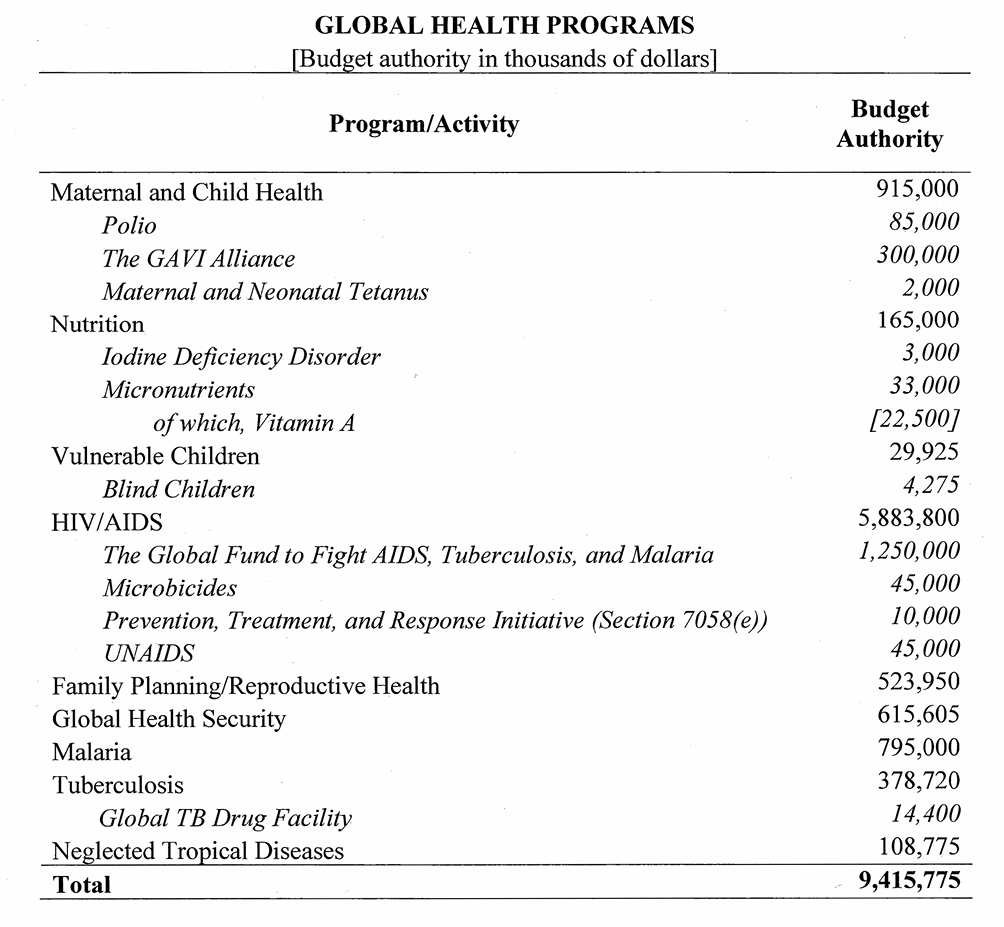
Of the $9.42 billion earmarked in the bill specifically for global health programs, some $5.9 billion would be allocated to HIV/AIDS – with $1.25 billion channeled through the Global Fund, $45 million for UN AIDS, and $4.6 billion through PEPFAR, the flagship US program founded in 2003. This represents $200 million more for PEPFAR, and a $400 million decrease (24%) for the Global Fund from FY25 levels.
And while less than the $7.1 billion level of support to these organizations under the Biden administration in FY24, it’s a major increase from the $2.9 billion for HIV/AIDS requested by Trump. At the same time, the Bill also calls for PEPFAR, founded by former US President George Bush, to transition to a largely self-reliant program of national governments over the coming years.
Other global health priorities still see strong funding: $795 million is dedicated to malaria, and $379 million for tuberculosis; $85 million is earmarked for polio.
Some $575 million for family planning and reproductive health services are also included in the funding package – despite the historic reticence of some conservatives to fund such programs, and the fact that the Administration requested no funds for these programs.
And although the administration has ordered a US withdrawal from the UN Population Fund (UNFPA), Congress allocated $32.5 million for the organization, as part of the family planning funds. The bill does stipulate that the agency cannot spend these funds on China – and that if the Trump administration makes good on its plan to withdraw from UNFPA, the money should then be transferred to other global health programs.
Allocations earmarked for “Global Health Security,” are $615.6 million for organizations like Pandemic Fund and the Coalition for Epidemic Preparedness Innovations (CEPI). While global health security overall was cut by about 12% from FY25, these funds could also be used in the event of a public health emergency.
Funds will also go to neglected tropical diseases (NTDs; $109 million) and nutrition ($165 million).
US to continue funding Gavi despite federal anti-vaccine rhetoric
In late January the US froze all funds to Gavi, the Vaccine Alliance, over concerns that the organization, which procures and delivers life-saving vaccines, provides vaccines with the preservative thimerosal.
And while the US FDA has stated that the preservative “has a long record of safe and effective use preventing bacterial and fungal contamination of vaccines,” the US plans to withhold the $300 million already allocated by the Biden administration but not yet paid, as well as any new funds.
Despite this, the newly passed FY26 bill does include another $300 million for a US contribution to Gavi. The Administration had requested Gavi funds be eliminated.
New ‘National Security Fund’ also includes health components
In another twist, support for family planning, reproductive health and countering child marriage is also supported through a new National Security Fund of $6.77 billion that Congress aims to create – to “combat China’s influence” among other things.
The fund, which also includes monies for clean cook stoves, a Young African Leaders Initiative, peace process monitoring, trade capacity building, and assorted other priorities, specifies that at least 15% of the fund should go to the African continent.