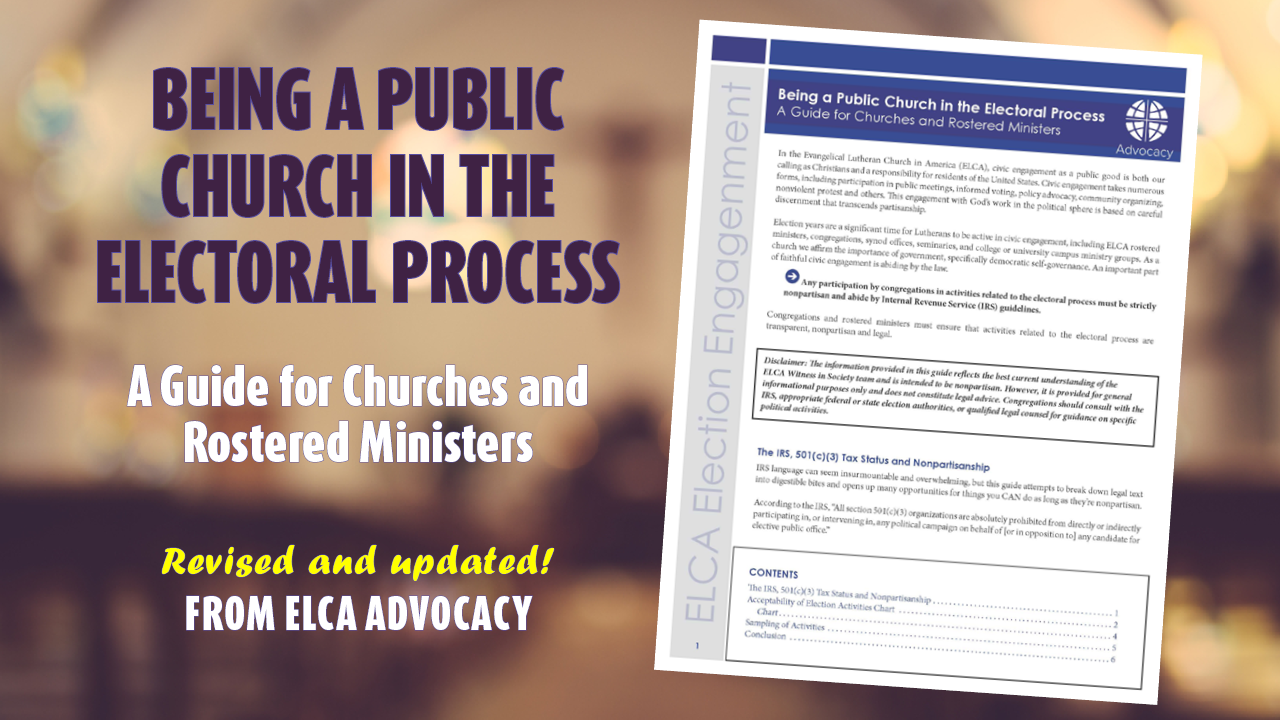
Being a Public Church in the Electoral Process: A Guide for Churches and Rostered Ministers (Updated 2026)
Guidance for Churches and Clergy participating in the electoral process
The ELCA resource “Being a Public Church in the Electoral Process” is a practical guide for congregations, rostered ministers, synods, seminaries, campus ministries, and church members who want to engage faithfully and legally during election seasons. Its central message is that civic engagement is part of Christian vocation, but any election-related activity by congregations must be strictly nonpartisan, transparent, and compliant with IRS rules for 501(c)(3) organizations.
The guide affirms that Lutherans are called to participate in public life through voting, advocacy, public meetings, community organizing, nonviolent protest, and other forms of civic engagement. At the same time, churches may not directly or indirectly support or oppose candidates for public office. The document emphasizes that violating IRS rules can jeopardize a church’s tax-exempt status.
A key section explains the difference between what churches, clergy acting on behalf of a congregation, clergy acting as private individuals, and church members acting as private individuals may do. Churches may hold nonpartisan voter registration drives, distribute carefully prepared nonpartisan voter guides, host issue discussions, encourage voting, offer Election Day hospitality, and hold prayer vigils. They may also host candidate forums only under strict conditions: all candidates must be treated equally, the event must remain nonpartisan, and no campaigning or fundraising may occur.
The guide also clarifies that rostered ministers and church members retain the right to participate personally in political life, including endorsing or supporting candidates as individuals. However, they may not imply that they are speaking for a congregation, synod, denomination, or church body when engaging in partisan activity.
The resource warns churches and church leaders to avoid endorsing candidates, contributing to campaigns, allowing candidate fundraising on church property, displaying partisan signs, coordinating election work with a political party or candidate, distributing partisan materials, or using church resources in ways that favor one candidate or party. It also urges caution with voter guides, candidate surveys, and candidate appearances, recommending legal consultation when needed.
The conclusion grounds this guidance in ELCA social teaching: Christians may disagree passionately on public questions, but they are called to deliberate together faithfully and engage public life through prayer, discernment, and concern for the neighbor. The resource ultimately encourages ELCA members to participate actively in democracy while preserving the church’s nonpartisan public witness.