ELCA Action Alert: Strengthen Hunger Provisions in the Farm Bill
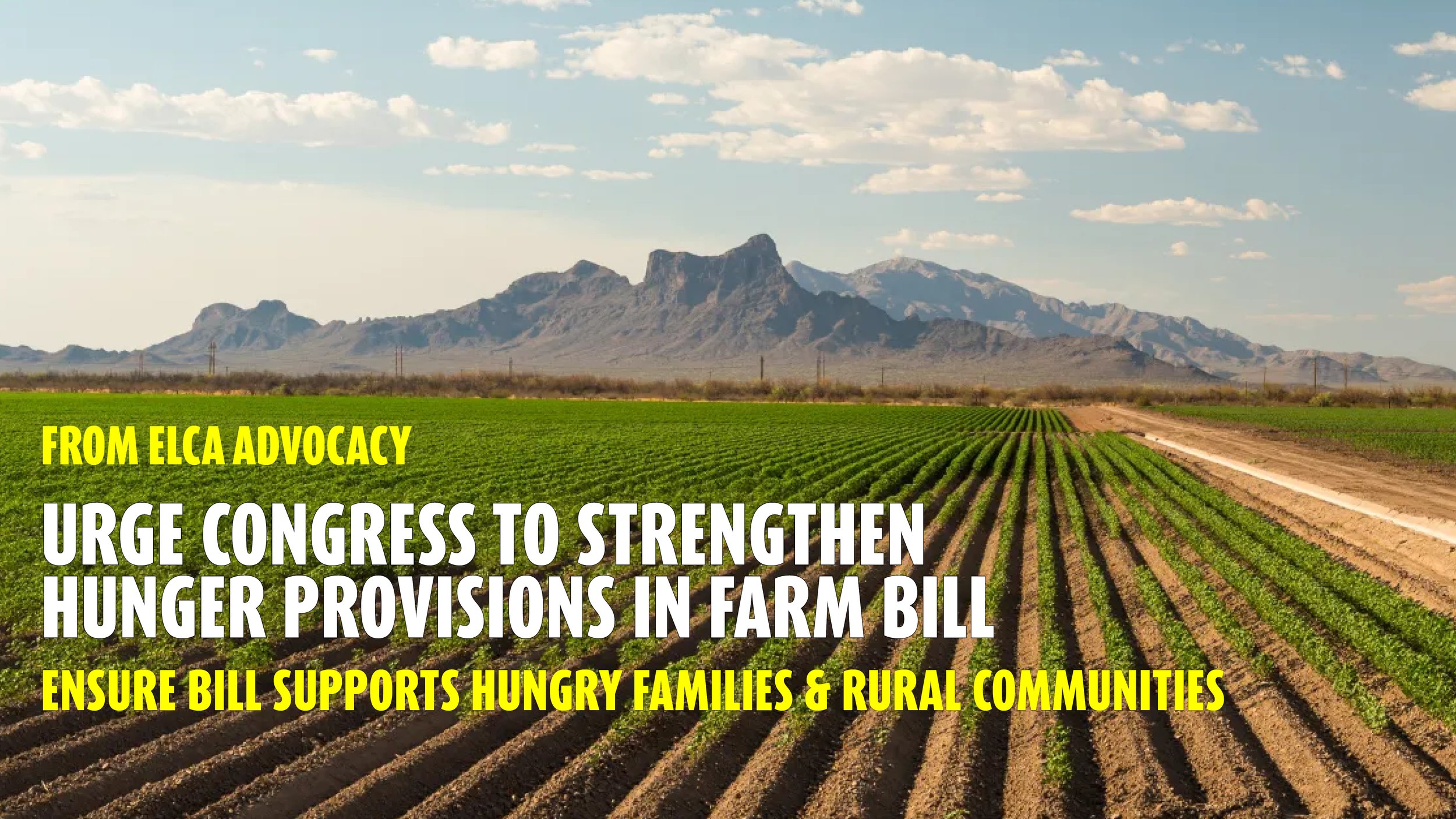
Deeply concerning Farm Bill proposals at risk of codification this week!
UPDATE 4/28/2026: The Farm Bill is advancing for a vote in the House of Representatives the week of Apr. 27, 2026. If passed, the bill would codify deep cuts to SNAP, while underfunding several rural development, conservation and farm provisions due to budget neutrality rules. This comes as many governors say the SNAP program could be in jeopardy in their state if Congress continues with these cuts, and as farmers are facing high production costs, unstable markets and more. Urge the House to vote NO today – and urge Congress to reconsider a good Farm Bill that supports both farmers and hungry families.
The ELCA Witness in Society office sent a letter to House members on Apr. 24, 2026, recommending several amendments that would help restore core hunger and farm programs in the legislation. The letter additionally highlighted some of the chronic needs facing food insecure members in our communities, the work of ELCA ministries and the steep challenges facing rural communities. This comes as other Lutheran leaders have highlighted the reality of hunger in their own states.
“In Arizona, participation in the Supplemental Nutrition Assistance Program (SNAP) has dropped by roughly 47% in the past year, the steepest decline in the nation,” writes Bishop Deborah K. Hutterer, ELCA Grand Canyon Synod, for example. “More than 400,000 of our neighbors, including many children, are no longer receiving help putting food on the table. These numbers are not abstract. They represent parents skipping meals so their children can eat, older adults navigating unfamiliar systems, and working families doing their best to make ends meet while finding that the systems meant to support them are increasingly difficult to access. As people of faith, we are called to pay attention when something so essential as daily bread becomes harder to obtain, not only because of individual need, but because of how our shared systems are functioning.”
The stories you can provide as clergy, volunteers and lay advocates are critical at this moment in time to illustrate to lawmakers the urgent needs of rural and food insecure families in their district.
The House of Representatives should know that what is known as a “skinny” Farm Bill is not what our country needs at this time – urge lawmakers to take action today, and encourage your neighbors to do the same.
Urge a bold, efficient Farm Bill which supports both hungry families and vital rural communities. Take action today!
The bill which advanced from the House committee in the spring includes some welcome provisions (noted below), such as restoring farm-to-foodbank programs, offering policy stability to farmers, boosting nutrition incentives that directly support the communities our ministries serve, and reauthorizing key international food aid programs. But it falls short in critical areas that must be addressed before it is sent to the president’s desk.
Amendment No. 201: (Hernández, PR) This amendment would start a transition plan for Puerto Rico to fully participate in the Supplemental Nutrition Assistance Program (SNAP). Food insecurity has been a striking problem in Puerto Rico which is compounded from natural disasters – as reported by many Lutheran disaster responders in the area.
Amendment No. 266: (Hayes, CT) This amendment would reverse harmful barriers to SNAP and the implementation of burdensome state cost shares that begin later this year. This comes as states across the country report that the program may be in jeopardy if no further changes are made, and as internal church data shows an over fifteen-fold increase in demand for hunger ministry grants.
Amendment No. 294: (Beyer, VA; Lawler, NY) This amendment would promote innovative practices for soil health and agroforestry in the Environmental Quality Incentives Program (EQIP) and Conservation Stewardship Program (CSP), both of which are highly competitive and oversubscribed USDA programs. Prioritizing these practices will improve resiliency and crop security in the face of natural disasters and increase environmental variability.
At a time when houses of worship, food pantries, global partners and ELCA World Hunger affiliates report alarming new rates of food requests in our communities, Congress should not use this moment to codify cuts which advanced during the budget reconciliation process last year. The Supplemental Nutrition Assistance Program (SNAP), for example, is now subject to imposed new work requirements, cost shifting to strapped state budgets, and elimination of benefits for refugees. The advancing Farm Bill also requires that at least 50 percent of Food for Peace aid, an international food assistance program authorized through the Farm Bill, be sourced from the United States and shipped on U.S. vessels. This will negatively impact how much funding is left for food aid programming in countries where it’s needed the most.
After years of temporary extensions, farmers and families need a bold, efficient Farm Bill that reflects our Lutheran commitment to promoting vitality to rural communities and hungry families. Read more on the ELCA Advocacy Blog.
Please contact your members of Congress today and urge them to strengthen hunger provisions in the Farm Bill.
THANK YOU for joining the ELCA in advocating for our neighbors experiencing hunger!
Find my members of Congress here.
Read the Action Alert in the ELCA Advocacy Action Center
Arizona Congressional Delegation
Senator Mark Kelly (D-AZ) (202) 224-2325, Email https://www.kelly.senate.gov/
Senator Ruben Gallego (D-AZ) (202) 224-4521, Email https://www.gallego.senate.gov/
Rep. David Schweikert (R-AZ01) (202) 225-2190 or (202) 225-0096, Email https://schweikert.house.gov/contact-form
Rep. Eli Crane (R-AZ02) (202) 225-3361, Email https://crane.house.gov/contact
Rep. Yassamin Ansari (D-AZ03) (202) 225-4065, Email https://ansari.house.gov/
Rep. Greg Stanton (D-AZ04) (202) 225-9888, Email https://stanton.house.gov/contact
Rep. Andy Biggs (R-AZ05) (202) 225-2635, Email https://biggs.house.gov/contact/email
Rep. Juan Ciscomani (R-AZ06) (202) 225-2542, Email https://ciscomani.house.gov/contact/offices
Rep. Adelita Grijalva (D-AZ07), (202) 225-2435, Email https://grijalva.house.gov/contact
Rep. Abraham Hamadeh (R-AZ08) (202) 225-4576, Email https://hamadeh.house.gov/
Rep. Paul A. Gosar (R-AZ09) (202) 225-2315, Email https://gosar.house.gov/contact/