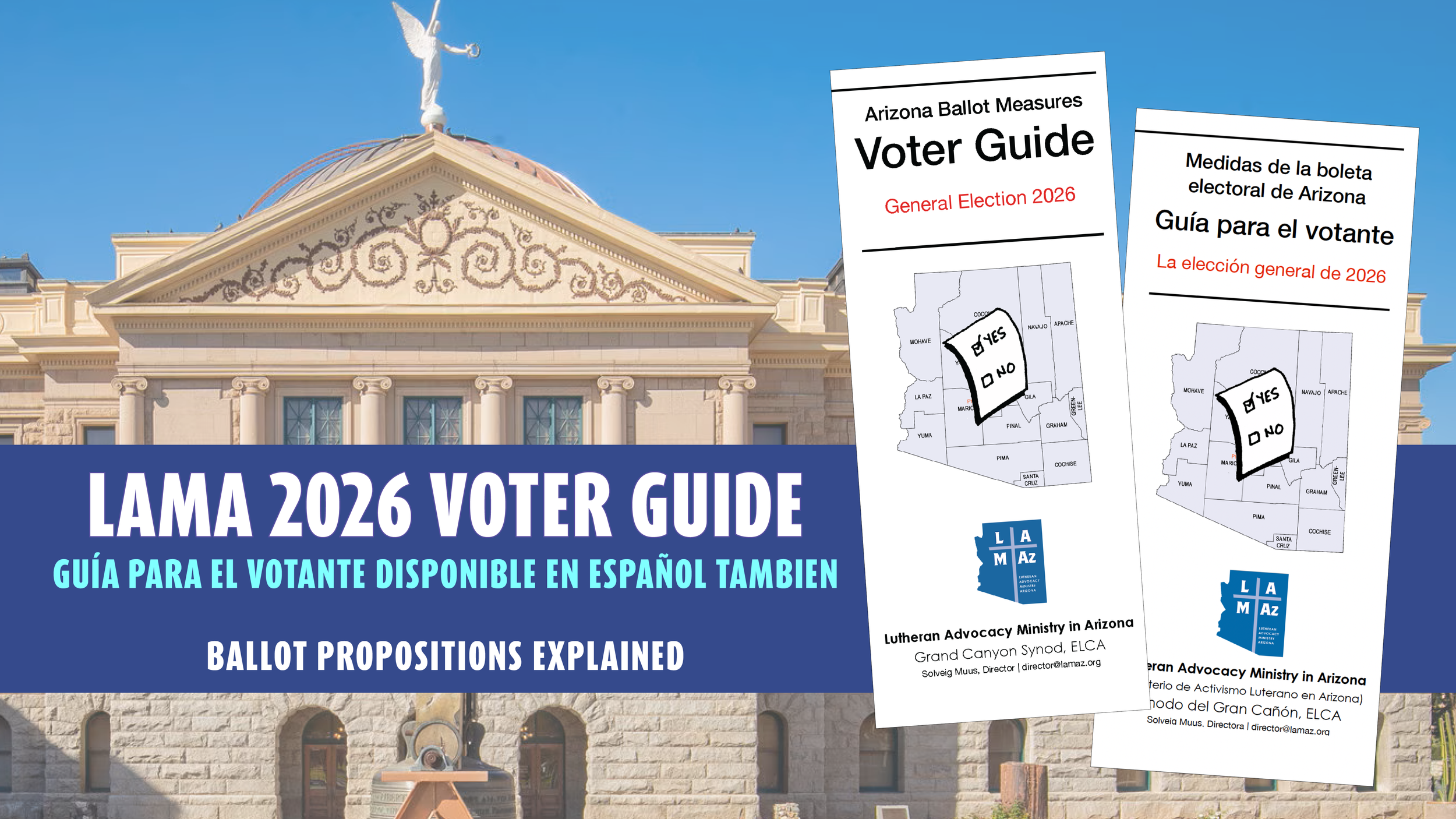
Introducing LAMA’s 2026 Voter Guide
Arizona voters once again have important decisions to make at the bottom of the ballot. There are 8 statewide ballot measures to consider this fall: 3 are proposed Constitutional Amendments; 5 were referred to the ballot from the state legislature.
In addition to choosing candidates for public office, Arizona voters are often asked to decide ballot measures that can change state law or amend the Arizona Constitution. These measures may look short on the ballot, but their effects can be long-lasting. Some are technical. Some are controversial. Some sound simple but include details that matter deeply for our neighbors, schools, communities and public life.
That is why Lutheran Advocacy Ministry Arizona prepares a voter guide.
LAMA’s 2026 Voter Guide is designed to help voters look beyond campaign slogans and consider ballot measures through the lens of Lutheran public witness. We do not tell people how to vote simply because an issue is politically charged. LAMA takes a position only when a measure connects clearly to LAMA’s policy priorities and to ELCA social teaching. Positions were adopted by the LAMA Policy Committee on September 1, 2026.
For 2026, LAMA’s priorities include food insecurity; civic engagement, including racial, gender and economic justice; support for public schools; health care; and housing and homelessness. In reviewing the measures, the LAMA Policy Committee also looked to ELCA guideposts: the equal God-given dignity of every person, special concern for people living in poverty or excluded from power, fair and accessible civic participation, dignified work and collective voice, and equitable, sufficient and effective funding for public education.
The ELCA describes social teaching as official teaching and policy that helps guide “moral discernment and action.” We take that seriously. Our positions are not based on party labels. They are based on a Lutheran understanding that faith is active in love, and love seeks justice in public relationships and social structures.
The ELCA social statement Faith and Civic Life: Seeking the Well-being of All reminds us that Christians are called “to take responsibility for the good of all through civic participation.” It also draws from Luther’s explanation of daily bread, which includes not only food and drink, but also “upright and faithful rulers” and “good government.” In other words, voting is not separate from faith. It is one way we care for the neighbor and seek the common good.
SHARE THIS GUIDE WITH INTERESTED FRIENDS AND FAMILY,
NEIGHBORS AND CONGREGATION MEMBERS.
This year, LAMA recommends NO on 4 measures and takes NO POSITION on 4 others.
Proposition 141: Vehicle-Mileage Taxes and Monitoring — No Position
A YES vote means Arizona state and local governments could not tax, monitor or limit vehicle miles traveled without voluntary consent, with limited exceptions.
A NO vote means state and local governments would retain the option to consider future vehicle-mileage taxes, monitoring or limits under existing law.
Proposition 141 would prohibit Arizona state and local governments from taxing or charging a fee based on miles driven. It would also prohibit government from monitoring or limiting miles driven without a person’s voluntary consent, with exceptions for interstate commercial vehicles and government-owned vehicles.
LAMA sees real concerns on both sides. Privacy matters. So do the burdens placed on rural and lower-income drivers, who often have no practical choice but to drive long distances for work, school, medical care, groceries or worship. Supporters of the measure raise understandable concerns about government tracking and about future transportation fees that could be felt unevenly across Arizona.
At the same time, the measure would place a broad transportation-funding restriction in the Arizona Constitution. Fuel-tax revenue is likely to decline as vehicles become more fuel-efficient and as more electric vehicles use the roads. Cities, counties and transportation planners may need future tools to maintain safe and reliable infrastructure. Lutheran social teaching asks us to consider stewardship, sustainability and the needs of the whole community, not only immediate tax concerns.
Because Arizona does not currently have a mileage tax, and because the proposal does not directly advance a stated 2026 LAMA priority, the Policy Committee recommends no position. Faithful voters may reasonably weigh privacy, rural burden, sustainable transportation funding and creation care differently.
Proposition 142: Government Preferential Treatment and DEI Restrictions — NO
A YES vote means public entities would be prohibited from race- or sex-based preferences and would face new limits on certain diversity, equity and inclusion programs, trainings and statements.
A NO vote means public entities would not face these new constitutional restrictions on DEI-related programs, trainings and statements.
Proposition 142 would prohibit state and local governments and public educational institutions from granting preferences or discriminating on the basis of race, sex, color, ethnicity or national origin. It would also restrict diversity statements, specified race-related trainings and courses, and public spending on offices, programs and policies designed with reference to race, ethnicity, intersectionality, gender identity or sexual orientation, subject to stated exceptions.
The measure’s equal-treatment language may sound appealing. Lutheran Christians affirm the God-given dignity of every person. We also reject discrimination. But the question is whether this proposal merely prohibits unfair discrimination, or whether it goes further and prevents public institutions from addressing real inequities.
LAMA’s civic-engagement priority expressly includes racial, gender and economic justice. ELCA teaching has long called the church to confront racism, seek justice across race and ethnicity, and recognize how social systems can exclude people from power. The ELCA’s public commitments also include concern for gender justice and the full dignity of LGBTQIA+ people.
Proposition 142 would restrict some of the very tools public institutions use to identify, study and respond to inequity. It could chill teaching, training, outreach, hiring practices and programs intended to help public institutions serve all people more fairly. Treating everyone “the same” can preserve unequal conditions when communities begin from different places because of historic exclusion, unequal access or ongoing discrimination.
For that reason, LAMA recommends NO. The breadth of the DEI and inclusion restrictions conflicts with LAMA and ELCA commitments to racial and gender justice, substantive fairness, and belonging.
Proposition 144: Voting, Voter ID and Election Administration — NO
A YES vote means Arizona would add voter-ID, citizenship, ballot-tabulation, foreign-contribution and early/mail-voting provisions to the state Constitution beginning in 2028.
A NO vote means these election-administration provisions would not be added to the Arizona Constitution.
Proposition 144 would reaffirm that only U.S. citizens may vote; require government-issued identification before every ballot is cast; require an option for election-day ballots to be tabulated at the voting location; prohibit foreign-national election spending; and authorize election laws, including early- and mail-voting laws, that are rationally connected to specified state interests. It would apply beginning in 2028 and require implementation funding.
Election integrity matters. Voters need to trust that elections are fair, secure and administered well. LAMA does not dismiss those concerns.
But election integrity and voter access must be held together. Citizenship is already required to vote. Repeating that requirement can obscure the measure’s more consequential changes, especially the requirement that government-issued identification be presented before every ballot is cast. The measure does not explain clearly how this would work for mail voters. That uncertainty matters in Arizona, where many eligible voters rely on early and mail voting.
The ELCA social message Government and Civic Engagement in the United States: Discipleship in a Democracywarns against antidemocratic exclusion, including restrictions that burden voters without ensuring access for all eligible people. The new ELCA social statement Faith and Civic Life teaches that the good of all must be discerned in common and that civic participation is part of seeking the well-being of all.
From LAMA’s perspective, the unresolved mechanics for mail-ballot identification create serious access concerns. Older adults, voters with disabilities, rural voters, tribal voters, naturalized citizens, people with limited transportation and people with unstable housing may be especially affected. The proposal also bundles several election and campaign-finance policies into one take-it-or-leave-it constitutional amendment.
LAMA recommends NO because the measure creates uncertain and potentially significant barriers to participation while combining several unrelated election policies. Secure elections should not come at the cost of avoidable barriers for eligible voters.
Proposition 316: Municipal Taxes on Food for Home Consumption — No Position
A YES vote means existing municipal grocery taxes would remain, but new grocery taxes or most increases would require voter approval and be capped at 2%, with nutrition-assistance purchases still exempt.
A NO vote means municipalities would retain their current authority over grocery-tax decisions under existing law.
Proposition 316 would not repeal existing municipal grocery taxes. Beginning after June 30, 2027, it would allow pre-2025 grocery taxes to continue but require voter approval for increases below a 2% cap. It would prohibit increases where the rate is already 2% or more. A jurisdiction without a pre-2025 tax could adopt one only with voter approval and at no more than 2%. SNAP and specified nutrition-program purchases would remain exempt.
LAMA’s hunger priority gives real weight to grocery affordability. Food taxes are regressive because lower-income households spend a larger share of income on necessities. ELCA teaching on economic life insists that human well-being includes access to daily bread and the necessities of life. When families are struggling to afford groceries, even small costs matter.
At the same time, this measure does not reduce existing grocery taxes. Its principal effect is to limit future local revenue choices. Cities and towns use local revenue for public safety, parks, libraries, housing responses, infrastructure and other services that also matter to vulnerable neighbors. A statewide cap cannot account for every municipality’s fiscal needs, especially in rural communities with limited tax bases.
This creates a real Lutheran tension. On one side is concern for household food affordability. On the other is concern for local government’s capacity to provide services that sustain community life. Both are legitimate concerns for people of faith.
Because no current grocery tax is reduced, and because the measure presents competing concerns about hunger, local services and municipal stewardship, LAMA recommends no position. Voters should study their own community’s circumstances carefully.
Proposition 317: Drug Cartels as Terrorist Organizations — No Position
A YES vote means Arizona would declare drug cartels to be terrorist organizations and direct the state homeland-security department to use lawful means against cartel threats.
A NO vote means Arizona would not adopt this statutory declaration or related direction to the state homeland-security department.
Proposition 317 would declare drug cartels to be terrorist organizations, direct the Arizona Department of Homeland Security to use all lawful means within its authority to address cartel threats, and state that the measure does not support a noncitizen’s federal asylum claim.
Lutherans oppose trafficking, violence and exploitation. Public safety is a proper function of government, and communities harmed by organized criminal activity deserve protection. Nothing in LAMA’s position should be read as minimizing the reality of cartel violence or the suffering it causes.
At the same time, LAMA is deeply concerned about rhetoric and policy that blur the distinction between criminal organizations and migrants, refugees or asylum seekers. Many people seeking safety are fleeing the very violence, extortion or trafficking networks named by this measure. Lutheran social teaching on immigration and human dignity calls us to protect vulnerable people, tell the truth about their circumstances and resist dehumanizing narratives.
The measure may also have limited legal effect. Federal law controls foreign-terrorist designations and asylum. The phrase “all lawful means” gives little guidance about priorities, safeguards, accountability or cost. The asylum disclaimer could reinforce confusion rather than clarify state authority.
For these reasons, LAMA recommends no position. We urge voters to distinguish clearly between cartels and the migrants, refugees and asylum seekers who may be harmed or exploited by them. Public safety and human dignity must be held together.
Proposition 318: School Athletics and Sex-Based Facilities — NO
A YES vote means school sports teams and athletics-related restrooms, locker rooms and showers would be restricted according to sex recorded on an original birth certificate, with expanded lawsuit provisions.
A NO vote means Arizona would not adopt these new statewide restrictions on school athletics and athletics-related facilities.
Proposition 318 would require public and private schools, colleges and athletic associations to designate teams by sex and bar students classified male at birth from female teams. It would also restrict use of restrooms, locker rooms and shower rooms integral to athletics according to sex recorded on the original birth certificate, and expand who may sue over violations.
LAMA recognizes that fairness in girls’ athletics deserves serious attention. Schools and athletic associations need thoughtful policies that support safety, opportunity and meaningful participation for all students.
But Proposition 318 imposes a categorical statewide rule on a small and vulnerable group of students. It leaves little room for age, sport, level of competition, medical care, individual circumstances or local discernment. It also risks increased stigma, isolation, litigation and conflict in schools.
ELCA public witness affirms the dignity and humanity of transgender and nonbinary people. In a 2026 pastoral message for Transgender Day of Visibility, Presiding Bishop Yehiel Curry called the church to recognize transgender people’s “ongoing struggle for safety, dignity and justice” and to advocate for policies that protect human dignity and oppose discrimination. That is directly relevant here.
LAMA recommends NO because the measure conflicts with ELCA commitments to dignity, safety and inclusion for transgender people. Fairness in athletics should be addressed without writing broad exclusion into state law.
Proposition 319: Photo Enforcement Systems — No Position
A YES vote means new photo traffic-enforcement systems would generally be barred after 2026, and existing systems would require local voter approval every ten years.
A NO vote means state and local governments would retain current authority to use or consider photo traffic-enforcement systems.
Proposition 319 would generally bar new state or local photo-enforcement systems unless a contract is signed by December 31, 2026. A locality with an existing contract would need voter approval at the next general election and every ten years thereafter or stop operating the system within 90 days.
This measure raises legitimate concerns on both sides. Supporters raise privacy, due-process, outsourcing and revenue-motive concerns. Opponents argue that camera enforcement can improve traffic safety, reduce speeding and red-light running, and help communities enforce traffic laws without dangerous roadside stops or extensive officer time.
Lutheran social teaching asks us to consider both personal rights and the well-being of the community. Traffic safety matters, especially for pedestrians, cyclists, children, older adults and neighborhoods with dangerous roads. Privacy and fair enforcement also matter, especially when fines and enforcement practices may fall unevenly on lower-income residents.
Because this proposal is not closely tied to a stated 2026 LAMA policy priority, and because the competing concerns do not yield a clear church-policy position, LAMA recommends no position. Voters may want to consider how photo enforcement has worked in their own community and whether local voter approval is the right safeguard.
Proposition 320: School-District Instructional Spending — NO
A YES vote means larger and urban school districts would be required to meet a 60% direct-instruction spending target or risk losing Classroom Site Fund money.
A NO vote means these new spending-ratio requirements and penalties would not be adopted.
Proposition 320 would require certain school districts to devote at least 60% of operational spending to direct instructional expenses, as defined by the Auditor General. A district below the target would have to increase its share by at least 0.5 percentage point annually. Persistent noncompliance could reduce Classroom Site Fund distributions by 25% per year, up to 100%, unless waived, with withheld funds redirected to compliant districts.
The goal of supporting classroom instruction is important. Students need excellent teachers, strong curriculum and meaningful classroom learning. But a single spending ratio does not tell the full story of what students need.
The ELCA social statement Our Calling in Education affirms the importance of education and public schools. Lutheran support for education has never meant instruction alone. Students also need transportation, counseling, special education support, school nurses, safe facilities, technology, nutrition, utilities, administration and family support systems. These services are not distractions from learning; for many students, they are what make learning possible.
LAMA and ELCA teaching support equitable, sufficient and effective funding for public schools. Proposition 320 substitutes a rigid accounting formula for that broader vision. It may especially harm larger and urban districts, districts with greater transportation needs, and districts serving students who require more support. Withholding Classroom Site Fund money from districts that are already struggling could deepen inequity rather than improve educational quality.
LAMA recommends NO because the measure substitutes a rigid ratio and escalating penalties for adequate, needs-based school funding. Arizona students deserve public schools funded according to real needs, not a one-size-fits-all formula.
Vote Ballot Measures First
Ballot measures matter. They shape public policy directly, and constitutional amendments can be difficult to change later. Yet many voters spend most of their attention on candidate races and arrive at the ballot propositions tired, rushed or uncertain.
Please do not skip the bottom of the ballot.
As people of faith, we enter public life with humility, conscience and concern for our neighbors—especially those whose voices are too often ignored. We ask: Who benefits? Who may be harmed? Does this measure protect the vulnerable? Does it strengthen fair participation, public schools, human dignity, health, housing, food security and the common good?
The ELCA reminds us that the gifts of God for civic life are available to all people. Christians do not have privileged knowledge about public policy, and we are called to seek out the sound ideas, values and contributions of others. LAMA offers this guide in that spirit: not as the last word, but as a faithful tool for discernment.
We invite you to read the measures carefully, share the guide with interested friends, family, neighbors and congregation members, and vote all the way to the end of your ballot.
Vote faithfully. Vote thoughtfully. Vote for the well-being of all.
The LAMA Voter Guide prints on 8.5 × 14 inch (legal size) paper.
La Guía del Votante de LAMA para 2026 disponible ahora!