Publicly, Boldly and Honestly: Why Lutherans Show Up
What does faith look like in public?
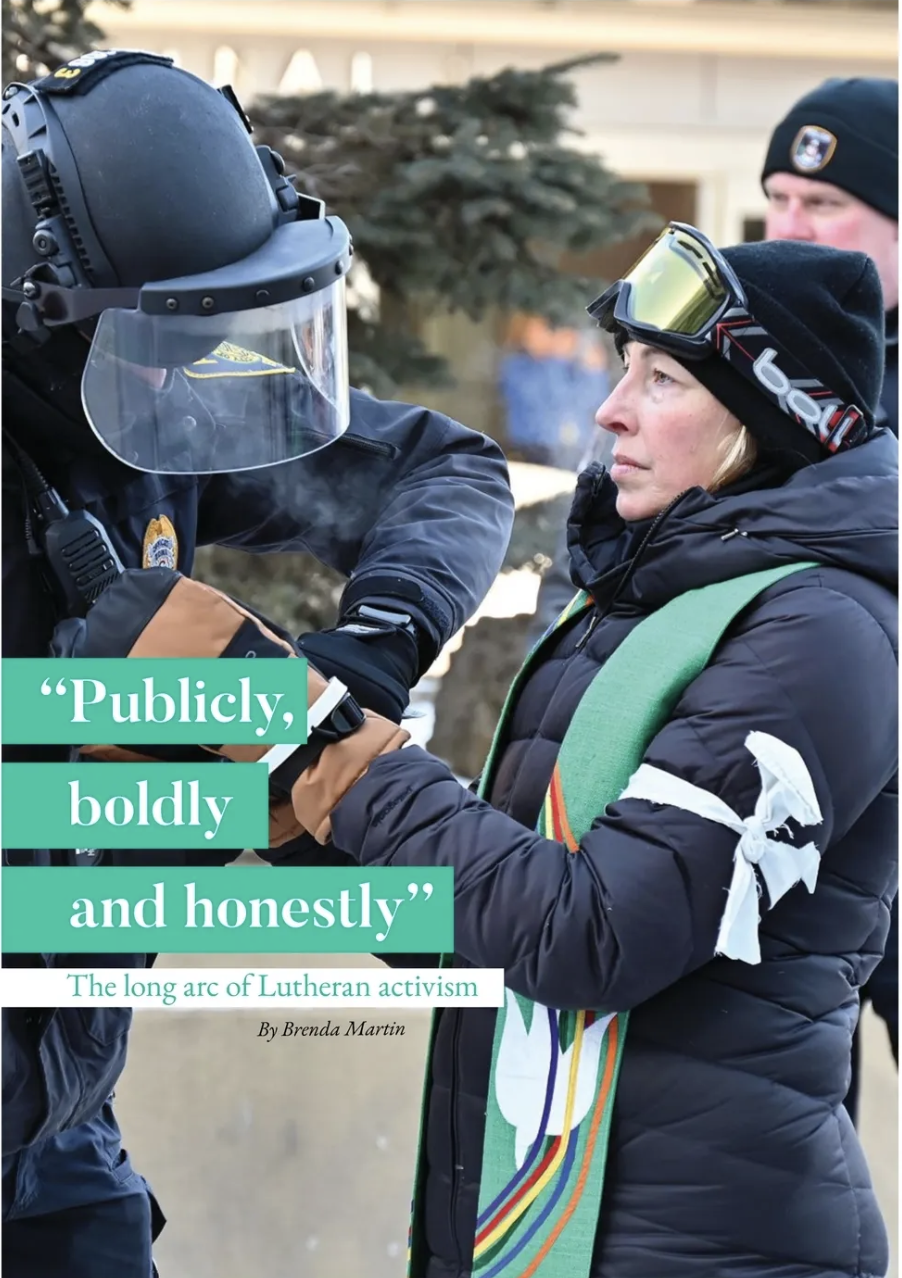
For Lutherans, it has often looked like prayer, service, feeding ministries, disaster response, accompaniment, letter-writing, public witness and, at times, protest. A recent (Summer 2026 p. 18) Living Lutheran article, “Publicly, boldly and honestly,” reminds us that civic engagement is not a departure from Lutheran faith. It is part of our long tradition of loving our neighbor in public.
The article by Brenda Martin tells the stories of ELCA members whose faith has moved them into visible public action — including clergy and lay leaders responding to immigration enforcement, standing with vulnerable neighbors, protecting children and families, joining public demonstrations, and working for civil rights, voting rights, hunger relief, immigrant justice and care for creation. Their witness is rooted not in partisanship, but in the gospel’s call to love the neighbor, especially those who are hungry, sick, imprisoned, displaced, excluded or afraid.
The accompanying study guide by Robert C. Blezard asks a question that is central to LAMA’s work: What does it mean not only to pull drowning people from the river, but also to go upstream and ask why they are falling in?
Congregations are often very good at throwing lifelines. We host food pantries, support shelters, provide clothing, accompany immigrants and refugees, care for the sick, and respond generously to urgent needs. These ministries are essential. But advocacy asks us to take the next faithful step: to look at the systems, policies and decisions that create hunger, homelessness, fear, poverty and exclusion in the first place.
That is why Lutheran Advocacy Ministry Arizona exists.
When we advocate for food security, affordable housing, health care access, voting rights, immigration justice, environmental care and dignity for all people, we are not “being political” in a partisan sense. We are practicing public discipleship. We are asking how our life together can better reflect God’s justice, mercy and care for the whole community.
The Living Lutheran resource also acknowledges that public faith can be uncomfortable. Christians do not always agree about how or when to speak out. Advocacy can be criticized as meddling, too bold or too risky. But Lutheran theology gives us strong grounding for public witness. The ELCA social statement The Church in Society: A Lutheran Perspective reminds us that speaking God’s word “publicly, boldly and honestly” can be a faithful service to God and neighbor.
Here in Arizona, that witness matters. Our neighbors are affected every day by decisions made at the state Capitol, in Congress, in city councils, on school boards and in public agencies. Public policy shapes whether families can afford rent, whether children have enough to eat, whether elders can access health care, whether immigrants are treated with dignity, whether voters can participate freely, and whether communities are prepared for extreme heat and climate-related disasters.
LAMA invites congregations, pastors, deacons, lay leaders and people of faith across the Grand Canyon Synod to reflect on this resource and ask: What does faithful public witness look like in our community right now?
Perhaps it begins with a Bible study. Perhaps it begins with a letter to an elected official, a call to a legislator, a voter registration table, a ministry partnership, a public prayer vigil or a conversation in your congregation about the needs of your neighbors.
However it begins, the call is the same: to love our neighbor not only privately, but publicly; not only quietly, but boldly; not only with compassion, but with courage.
This is the long arc of Lutheran advocacy. And it continues with us.
Study Guide author Rob Blezard is a retired ELCA pastor living in Maryland. He earned a Master of Divinity degree from Boston University School of Theology and has done further study at the Lutheran Theological Seminary at Gettysburg (Pa.), now called United Lutheran Seminary.