Arizona's food stamp program sees largest decline in US. Here's why
Article by Ray Stern, reprinted from Arizona Republic, published Monday, April 13.
Key Points
Arizona has seen a 47% decline in food stamp participation, the largest of any state, due to new eligibility rules and a shortage of state workers.
A new federal law, H.R. 1, has toughened work requirements and changed age exemptions for SNAP recipients.
Arizona faces federal pressure to lower its payment error rate or risk having to pay a portion of SNAP benefit costs.
Cole Randall was frustrated on April 9 as he filled out an application for food stamps on top of a utility box outside of a state agency office.
The 32-year-old man tried to apply two months ago and was stymied by the Arizona Department of Economic Security phone system, he said. He was told he’d have a two-hour wait before he could submit a form and talk to someone, he said.
“This is so hard I’ve thought about moving back to Washington state,” he said, adding that state’s system would produce an EBT card for him in just 30 to 45 minutes.
He’s far from alone in his experience.
New eligibility criteria and a shortage of state workers have reduced the number of Arizonans participating in the Supplemental Nutrition Assistance Program, also known as food stamps, by 424,000 people.
The 47% decline is the largest of any state, but other states’ program participation has fallen, too, according to a new report.
“The new requirement that most states pay for part of SNAP benefits — totaling billions of dollars across all states — will put enormous fiscal pressure on them,” said the April 8 report by the Washington, D.C.-based, left-of-center Center on Budget and Policy Priorities. “States that can’t make up for these massive federal cuts by raising taxes or cutting other vital services will have to further cut SNAP.”
The decline may grow even larger because the likelihood of budget cuts and more eligibility restrictions Arizona lawmakers are planning to introduce, the report said.
Republicans in the Arizona Legislature hope to see more “abuse” cut from the system, which would mean fewer people able to get the benefits.
“You’re not being mean,” state House Majority Leader Michael Carbone of Buckeye told The Arizona Republic. “There’s just people that don’t qualify. Just like joining the YMCA or the racquetball club.”
Democrats, including Gov. Katie Hobbs, don’t want to see so many people lose access to the program.
But the new federal rules mean if Arizona can’t cut more participants from SNAP, the state will lose tens of millions of dollars during a lean budget year, which could lead to cuts of other services.
Big Beautiful Bill criteria leads to fewer SNAP recipients
The Big Beautiful Bill, formally known as H.R. 1, signed by President Donald Trump on July 4, toughened up requirements for people who want SNAP benefits.
Many of the changes affect work requirements for people without disabilities or dependent children. Without some kind of exemption, they can only receive assistance over a three-year period — and exemptions are now harder to receive.
Changes include raising the age exemption from 54 to 64, canceling exemptions for many veterans and former foster children, and lowering the age exemption for a dependent child in the household from 18 to 14.
"DES is currently navigating one of the most significant structural changes to federal nutrition assistance in decades," said the agency's spokesperson, Brett Bezio. "The 'drop' in cases reflects Arizona’s diligent and immediate implementation of H.R. 1 requirements."
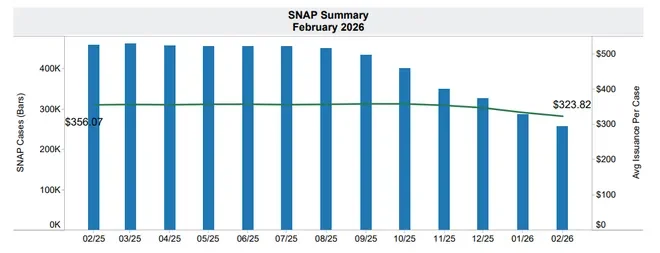
Arizona had over 400,000 fewer SNAP recipients after President Donald Trump signed the federal H.R. 1 law, which changed eligibility requirements. Provided by Arizona Department of Economic Security.
The average amount of SNAP payments received by a household in Arizona has also fallen since Trump signed H.R. 1, from $356.07 to $323.82 per month.
Another factor impacting SNAP participation was the layoff of about 500 DES workers, including many SNAP administrators, more than a month before Trump signed H.R. 1. At the time, DES said the layoffs occurred because of the elimination of federal grants to help the state pay for unemployment insurance and a shift of expenses due to other federal decisions.
More people likely to be kicked off program
The state still needs to bring down the SNAP program's error rate, a federal guideline that tracks how many recipients receive too little SNAP benefits and how many receive too much based on their eligibility. Out of a total payment error rate of 8.84% in 2024, overpayments were about six times higher than underpayments, state statistics show.
The new federal standards demand a lower error rate and will punish Arizona with extra costs if that's not met. The federal government currently pays 100% of SNAP benefits. But starting in October, the state will have to pay one-tenth of the costs in 2028, or about $139 million, if the error rate is between 6% and 10%, according to the Joint Legislative Budget Committee.
DES has been on a corrective-action plan since 2022 because of its relatively high overpayment rate, most of which are related to mistakes in determining a participant's household income, an Arizona Auditor General report said in September.
Reducing the error rate will safeguard SNAP long-term, Bezio said, "ensuring the program remains a stable source for vulnerable Arizonans."
Both Gov. Hobbs and Republicans in the Legislature want the state to save money by reducing the error rate as the new law requires. Although Hobbs said in December she would give $7.5 million to DES to reduce the long wait times caused by the layoffs, her executive budget proposal states the money will be used to reduce the SNAP error rate.
"We’re trying to justify, make sure, that we are getting our error rate down to the level that the federal government says we need to get it down to so we don’t entirely lose funding," Hobbs said during a news conference on April 9. "It’s a very complex process and we’re doing what we can to ensure that we’re complying and people that need benefits can get them.”
Compounding that problem: The federal government already increased the state share of the administrative cost to run the SNAP program in Arizona from 50% to 75%. That will cost about $77 million over the next two years.
Republicans trying for redo on slate of SNAP restrictions
House and Senate Republicans who normally support the idea of reduced government created a long list of bills this year that would help reduce the error rate and the number of people who use the program.
The bills sought to ban SNAP recipients from using the funds to buy unhealthy food, scrutinize applicants for gambling winnings or out-of-state income, require new work-training requirements for most applicants under 60, seek information from employers about SNAP recipients who refused a job offer, and make other changes. One of the bills would also require many hospitals to ask patients about their immigration status, while others addressed eligibility for the state's health care, unemployment and welfare programs.
Hobbs vetoed all of them, saying in a veto letter the proposals duplicated DES accuracy efforts and would "disrupt" the agency's operations.
SNAP supporters said the state should proceed carefully to avoid kicking out people who truly need the help, and that overpayments seen in SNAP error rates don't necessarily mean someone is trying to game the system.
Take gig workers, said Joseph Palomino, executive director of the liberal-leaning Arizona Center for Economic Progress. A rideshare driver might earn money by working many hours one week, but not make the same amount the next week, a scenario that would impact SNAP eligibility, he said.
"I think we have to understand SNAP is a complex program that is meant to be so, and it's also meant to be flexible," he said.
Republicans are trying for a redo. They put all the rejected proposals in another bill that would renew the legal right of DES to operate for another four years. If Hobbs vetoes that bill, which still needs to pass the House and Senate, DES would technically be terminated July 1.
"This is a dangerous and irresponsible tactic," said Liliana Soto, Hobbs' spokesperson. "Republicans are holding a critical agency hostage by stuffing vetoed bills into the DES continuation to push their agenda at the expense of everyday Arizonans."
Negotiations between Hobbs and Republican legislative leaders could break the stalemate. But even if Hobbs rejects the DES renewal, the agency won't disappear. State law requires a terminated agency to make no changes for six months, giving the governor and Legislature time to save it.
Food banks step up
In late October, Hobbs released $1.8 million in state funds to help subsidize the state's food banks as SNAP participation began to fail.
They need even more help, said Terri Shoemaker, executive vice president for the Arizona Food Bank Network, a group that coordinates resources of several food banks.
After the new H.R. 1 eligibility requirements went into effect, more Arizonans began participating in food banks than in the SNAP program, Shoemaker said. A graph created by the group shows more than 500,000 SNAP participants in January, but more than 600,000 food bank recipients.
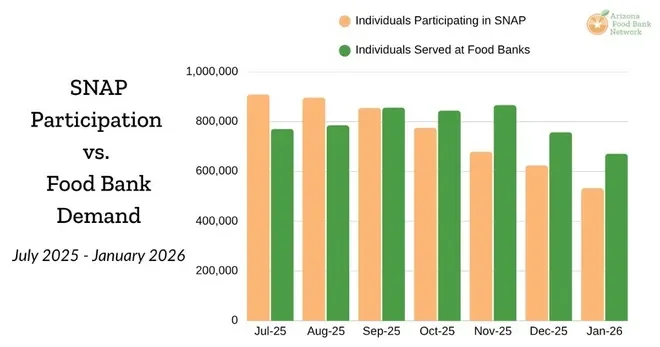
More people accessed food banks for food assistance than the federal food-stamp program for the first time ever after Congress passed H.R. 1, which included new SNAP eligibility restrictions. Provided by Arizona Food Bank Network.
Yet SNAP dollars buy about five times as much food as a typical food bank offering, she said. Fortunately, children in Arizona no longer on SNAP likely take advantage of free school lunch and breakfast programs.
"Food banks shouldering this burden right now is especially difficult due to those rising costs of fuel," she said, adding that food banks will continue to help people "no matter what happens."