New Resource Helps Congregations Prepare for Election-Related Disruption
Preparation is not prediction. It is faithful stewardship.
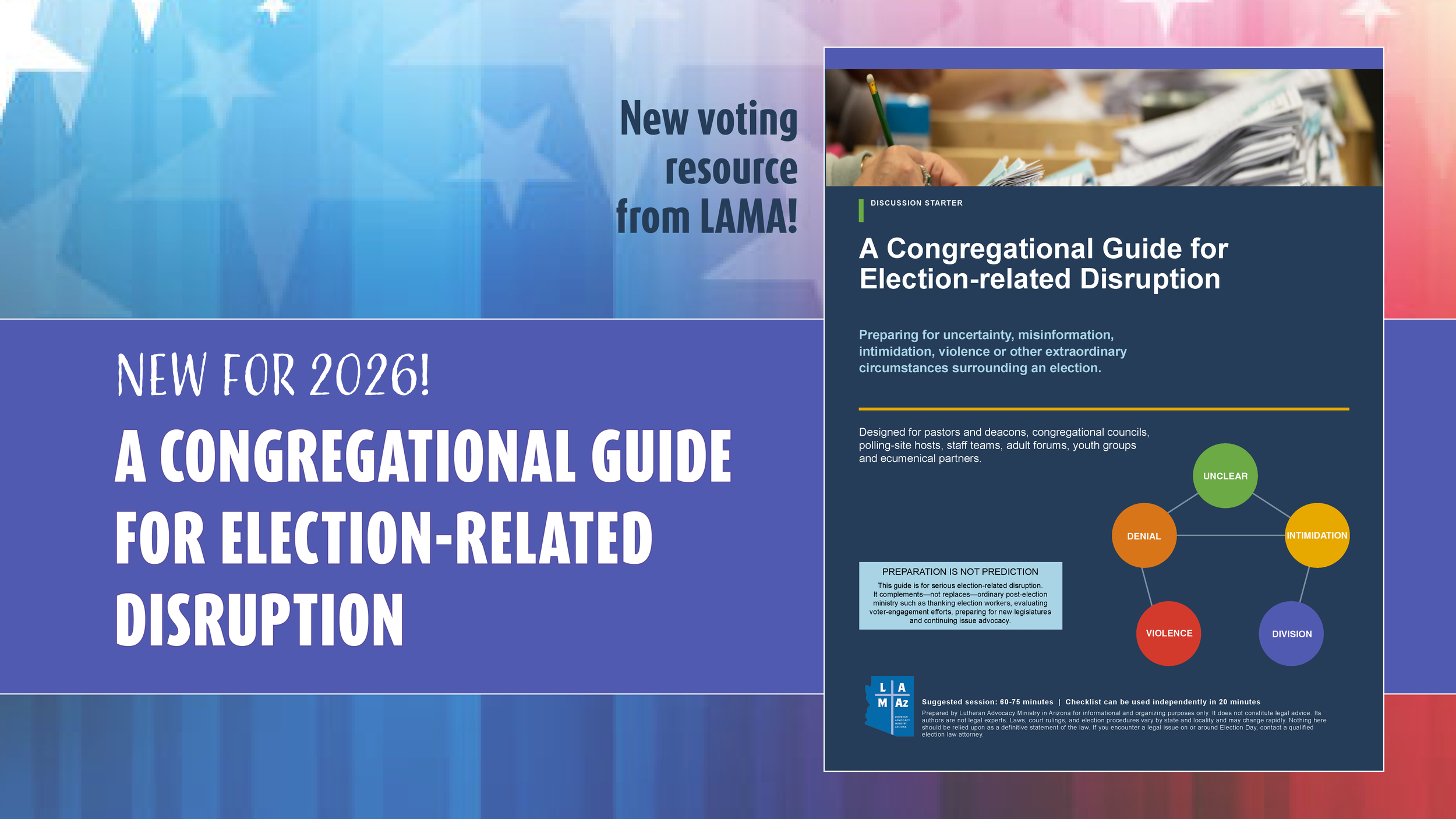
In preparation for the midterm election season, Lutheran Advocacy Ministry Arizona has created A Congregational Guide for Election-Related Disruption to help congregations prepare for extraordinary circumstances surrounding an election—including uncertainty, misinformation, intimidation, violence or an unexpected armed presence at a polling place.
This 8-page guide is designed for pastors and deacons, congregational councils, polling-site hosts, staff teams, adult forums, youth groups and ecumenical partners. It may be used as a 60- to 75-minute discussion starter, while its final readiness checklist can be completed independently in about 20 minutes.
Begin with readiness
The guide does not assume that disruption will occur. Nor does it replace the ordinary work congregations should undertake after an election: thanking election workers, evaluating voter-engagement efforts, preparing for new legislative sessions and continuing issue advocacy.
Instead, it asks congregations to make several basic decisions before a crisis:
Who will serve on a small response team?
Which information sources will the congregation trust?
Who is authorized to speak publicly?
How will leaders care for people who may be frightened or particularly affected?
What election, emergency, synod and community contacts should be readily available?
What will the congregation say while important facts are still being verified?
The guide explains how to prepare a short “holding statement”—a temporary, factual and compassionate message that acknowledges a situation, distinguishes what is known from what remains uncertain and tells the audience when to expect an update.
Six scenarios for discussion
Participants are invited to consider how their congregation might respond to six possible situations:
No clear election result—and pressure to declare a winner.
Widespread election denial.
Intimidation or disruption at a polling place.
An unexpected armed, militarized or federal presence at a church polling location.
Violence, vandalism or property destruction.
A peaceful result that nevertheless leaves the congregation deeply divided.
Each scenario includes questions about what is known, who may be at risk, whom to contact, what the church can responsibly do and what it should refrain from doing.
Grounded in Lutheran faith
This is not simply an emergency-management guide. Its theological anchors draw from Scripture, Luther’s explanation of the Eighth Commandment and ELCA social teaching—including Faith and Civic Life: Seeking the Well-Being of All and For Peace in God’s World.
That social statement describes the church as a community that “disturbs, reconciles, serves and deliberates.” In an election-related crisis, the church may be called to expose deception and injustice, sustain communication across differences, stand with people at risk, seek justice and create space for responsible discernment.
Being nonpartisan does not require silence about intimidation, racism, dehumanization, violence or attacks on democratic participation.
Becoming trusted messengers
Congregations often possess something especially valuable during a confusing or frightening moment: relationships of trust.
Presiding Bishop Yehiel Curry’s message, “A Call to Be Trusted Messengers in This Election Season,” reminds church leaders that they can help neighbors find accurate information and participate confidently.
The guide encourages trusted messengers to lead with care, name their sources, distinguish verified facts from allegations and opinions, correct errors without humiliating people and say “we do not yet know” when facts remain incomplete.
Use the checklist now
Congregations do not need to complete every discussion scenario before beginning. Start with the final checklist. Name a response team, record essential contacts, choose trusted sources, identify a spokesperson and review emergency procedures.
Churches that serve as polling locations should also clarify responsibilities with their local election office before Election Day. Election officials—not congregational volunteers—direct polling operations and control voting equipment.
This guide is intended for education, conversation and congregational organizing; it does not constitute legal advice. Election procedures and state laws vary, so churches should consult their state and local election offices and qualified legal counsel when necessary.
Additional nonpartisan resources are available through the ELCA Civic Engagement webpage.